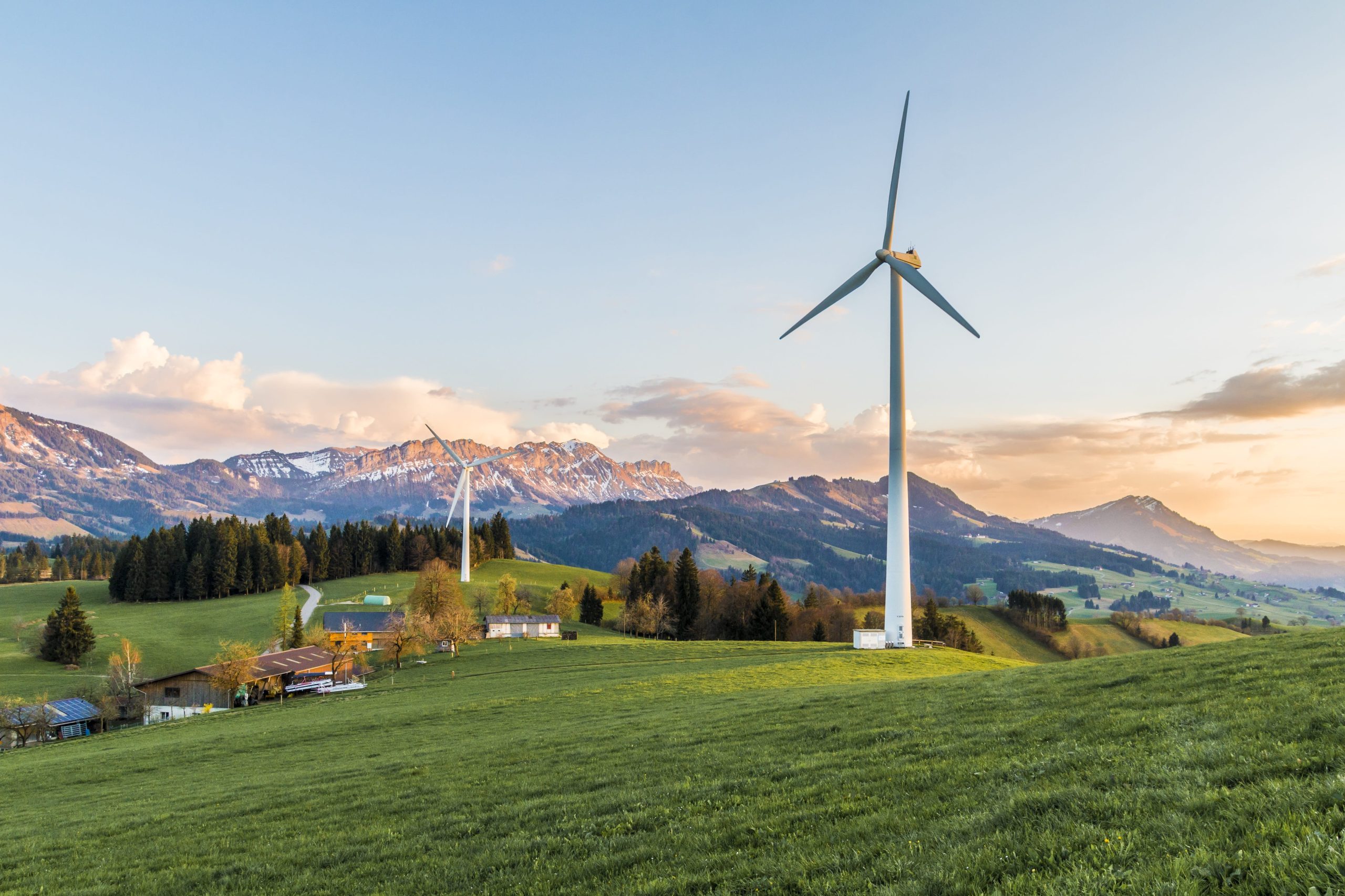
In a world where countries are racing to generate more renewable energy, solar PV is often seen as a fast and affordable way to produce clean electricity. It is relatively quick to install, requires no fuel during operation, and has low maintenance needs. However, solar panels are not the only way to capture the sun’s energy. Through photosynthesis, plants also capture solar energy and store it as chemical energy in biomass, which can later be converted into electricity, heat, or fuels.
Both solar PV and bioenergy are considered renewable energy sources because they can continue producing energy as long as the sun keeps shining and plants continue to grow on Earth. But are both truly clean energy sources? Solar PV directly converts sunlight into electricity, with no direct carbon emissions during operation. Bioenergy, by contrast, stores carbon in biomass during plant growth and releases it when the biomass is converted into energy, for example through combustion.
In theory, the carbon released during combustion can be balanced by the carbon absorbed during plant growth, resulting in net-zero biogenic carbon emissions. However, biomass often needs to be processed before it can be used as energy, such as through pelletizing or conversion into biogas or biofuels. It may also need to be transported from plantations or collection sites to power plants or end users. These activities can produce additional emissions. Therefore, lifecycle assessment is needed before claiming that bioenergy is fully net-zero, although its emissions can still be much lower than fossil fuels.
Compared with many other energy sources, both solar PV and bioenergy can require significant land area, although the type of land use is different. For solar PV, the land is mainly used for installing the panels and supporting equipment. IESR used a land requirement of 2.44 ha/MWp for solar PV in its model, while also noting that recent ground-mounted solar PV projects in Indonesia have used less land (IESR, 2021), such as 0.8 ha/MWp in Purwakarta (Kementerian ESDM, 2024) and 1.5 ha/MWp for the Kupang solar power plant (Kementerian ESDM, 2020). In practical terms, this means that a solar PV plant may require roughly 80×100 m to 250×100 m of land for every 1 MWp of installed capacity.
For bioenergy, however, the largest land requirement is usually not for the power plant itself, but for producing the feedstock. In a dedicated energy plantation scenario, IEA (2007) estimated that around 240 ha of energy forest plantation would be required for every 1 MWe of power plant capacity, assuming land productivity of 15 tons/ha/year, 35% power plant efficiency, and 7,000 operating hours per year.
However, bioenergy does not always require new dedicated plantation land. Agricultural residues such as rice straw, rice husk, bagasse, and corn cobs can be used as bioenergy and minimize additional land requirements, leaving mainly the area needed for the power plant and processing facilities. For example, a 165 MW biomass power plant in Thailand occupies 2.62 ha of land (Biomass Electricity Company Limited, 2008), while a 50 MW wood pellet biomass power plant in Japan occupies 4.5 ha (JAPEX, n.d.). If the feedstock comes from existing agricultural residues, this facility-level land footprint can be much lower than ground-mounted solar PV, which requires at least around 0.8 ha for every 1 MWp of installed capacity. In addition, using agricultural residues for bioenergy can help reduce unused waste. However, one key challenge is ensuring that the quantity, quality, and continuity of available residues are sufficient to support the bioenergy project.
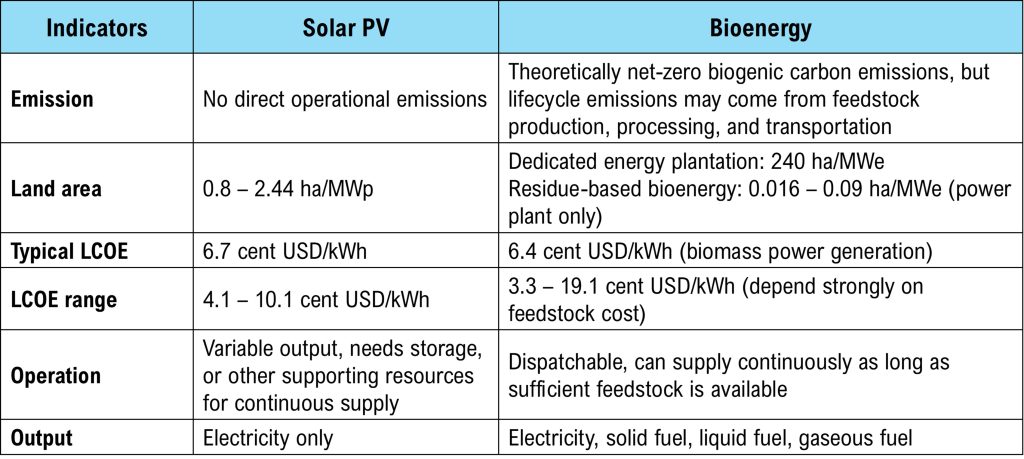
Another important aspect is cost. For ground-mounted solar PV projects of at least 10 MW, IESR (2023) estimated an LCOE (levelized cost of electricity) of 6.7 cent USD/kWh. IESR also projected that this figure could decline in the future, from 4.2 cent USD/kWh in 2030 to 3.3 cent USD/kWh in 2050. For biomass power plants, IESR estimated a typical LCOE of 6.4 cent USD/kWh. However, this value is highly dependent on feedstock cost, so the LCOE can be as low as 3.3 cent USD/kWh but can also reach 19.1 cent USD/kWh. Unlike solar PV, IESR did not project a significant cost reduction for biomass power plants in the future. Therefore, solar PV and biomass have comparable typical costs, but biomass power plants have a much wider cost range due to feedstock cost uncertainty.
One important point about solar PV is that it is a variable renewable energy source. It cannot generate electricity at night and is highly dependent on weather conditions. Therefore, if solar PV is expected to supply electricity continuously, it needs support from other technologies or system resources, such as battery energy storage systems, grid interconnection, or other dispatchable power plants. Without these supporting resources, solar PV is better suited to an existing grid, where other power plants or storage systems can help supply electricity when solar generation is low. Bioenergy, on the other hand, can provide a more continuous energy supply as long as sufficient feedstock is available, because biomass itself acts as a form of stored energy.
Another difference is the form of output. Solar PV mainly produces electricity, which is useful for applications such as electric vehicles, but more difficult to use directly in sectors that still rely on combustion-based fuels, such as shipping, aviation, and industrial boilers. Bioenergy can be converted into several energy carriers, including solid biomass, biogas, biofuels, biodiesel, bioethanol, and sustainable aviation fuel.
The better option depends on local energy needs. Solar PV is well suited to increasing renewable electricity supply where grid flexibility, storage, or backup resources are available. Bioenergy is more suitable where reliable biomass residues exist, dispatchable renewable energy is needed, or fossil liquid fuels must be replaced. Rather than being direct substitutes, solar PV and bioenergy serve complementary roles in the energy transition.
References
Biomass Electricity Company Limited. (2008). Environmental Assessment Report (Thailand: Biomass Power Project). Asian Development Bank (ADB).
IEA. (2007). Bioenergy Project Development & Biomass Supply. Paris: International Energy Agency.
IESR. (2021). Beyond 207 Gigawatts: Unleashing Indonesia’s Solar Potential. Institute for Essential Services Reform.
IESR. (2023). Making Energy Transition Succeed: A 2023’s Update on The Levelized Cost of Electricity and Levelized Cost of Storage in Indonesia. Jakarta: Institute for Essential Services Reform (IESR).
JAPEX. (n.d.). Tahara Biomass Power Plant. Retrieved from JAPEX: https://www.japex.co.jp/en/business/electricity/taharabiomass/
Kementerian ESDM. (2020, February 14). PLTS Kupang Sokong Kebutuhan Listrik Pulau Timor. Retrieved from Kementerian ESDM: https://www.esdm.go.id/id/berita-unit/direktorat-jenderal-ketenagalistrikan/plts-kupang-sokong-kebutuhan-listrik-pulau-timor
Kementerian ESDM. (2024, August 30). Bukti Nyata Pengembangan Energi Terbarukan, PLTS Ground-Mounted Terbesar di Indonesia Resmi Beroperasi. Retrieved from Kementerian ESDM: https://www.esdm.go.id/id/media-center/arsip-berita/bukti-nyata-pengembangan-energi-terbarukan-plts-ground-mounted-terbesar-di-indonesia-resmi-beroperasi.