For years, Indonesia’s gas policy has been shaped by a dominant paradigm: pipeline gas is cheaper, LNG is more expensive, and LNG therefore plays a supplementary role. That logic was reasonable when pipeline gas formed the backbone of supply and LNG served primarily as a balancing instrument. But the physical system has changed—quietly—while the mindset has not fully caught up.
A That Has Quietly Flipped: a Case in West Java
Field conditions indicate that effective pipeline gas supply into Java—particularly West Java—has already fallen below LNG supply, and the gap is likely to widen.
The drivers are structural:
- Declining legacy supply from Sumatra, which historically underpinned deliveries to Java.
- Offshore Java no longer serves as a strong anchor at previous production levels.
In other words, the system is moving away from a “pipeline-first” default. LNG is no longer merely filling supply gaps; it is becoming central to maintaining supply reliability.
West Java’s Gas Supply Evolution: from Offshore Java, to Sumatra, and now LNG.
A clearer picture emerges when we trace how gas supply into West Java has evolved over time.
West Java’s gas system was originally anchored by offshore Java fields, developed to supply power generation and strategic industries, including the Cilegon steel complex in the 1970s. In the early 2000s, offshore Java could deliver around 500 MMSCFD. That contribution remains relevant today, but at a significantly lower level, roughly 200 MMSCFD—and, in the absence of major new developments, it is likely to continue declining.
To compensate, West Java increasingly relied on pipeline inflows from Sumatra, but this pillar has also weakened. Deliveries to Java are now estimated at around 400 MMSCFD, down from roughly 900 MMSCFD about 15 years ago.
Taken together, total effective pipeline supply into the West Java market is now around 600 MMSCFD (approximately 200 MMSCFD from offshore Java plus about 400 MMSCFD from Sumatra), and the overall trend remains downward.
By contrast, LNG has already become the dominant—and growing—source of supply into Java. LNG currently accounts for roughly 80% of the combined regasification capacity of the three FSRUs. LNG send-out is widely expected to increase further, potentially approaching double today’s level within the next five years, as LNG is positioned not merely for peak shaving but as a practical replacement for declining pipeline deliverability.
Meanwhile, the core transmission capacity of SSWJ I & II from Sumatra remains broadly unchanged. Even if incremental additions materialize, such as through the Gresik–Cirebon corridor, often cited as capable of adding more than 100 MMSCFD, the broader conclusion is unchanged: LNG is no longer a marginal supplement. It is becoming the backbone of supply.
These figures signal a structural shift: more than half of current supply is already coming through LNG, and that share is likely to rise further in the near term.
When LNG becomes the backbone, the bottleneck becomes logistics
Pipeline systems are primarily constrained by reservoir performance, processing capacity, and allocation. LNG systems, however, introduce a different operational reality: reliability becomes a shipping-and-logistics challenge.
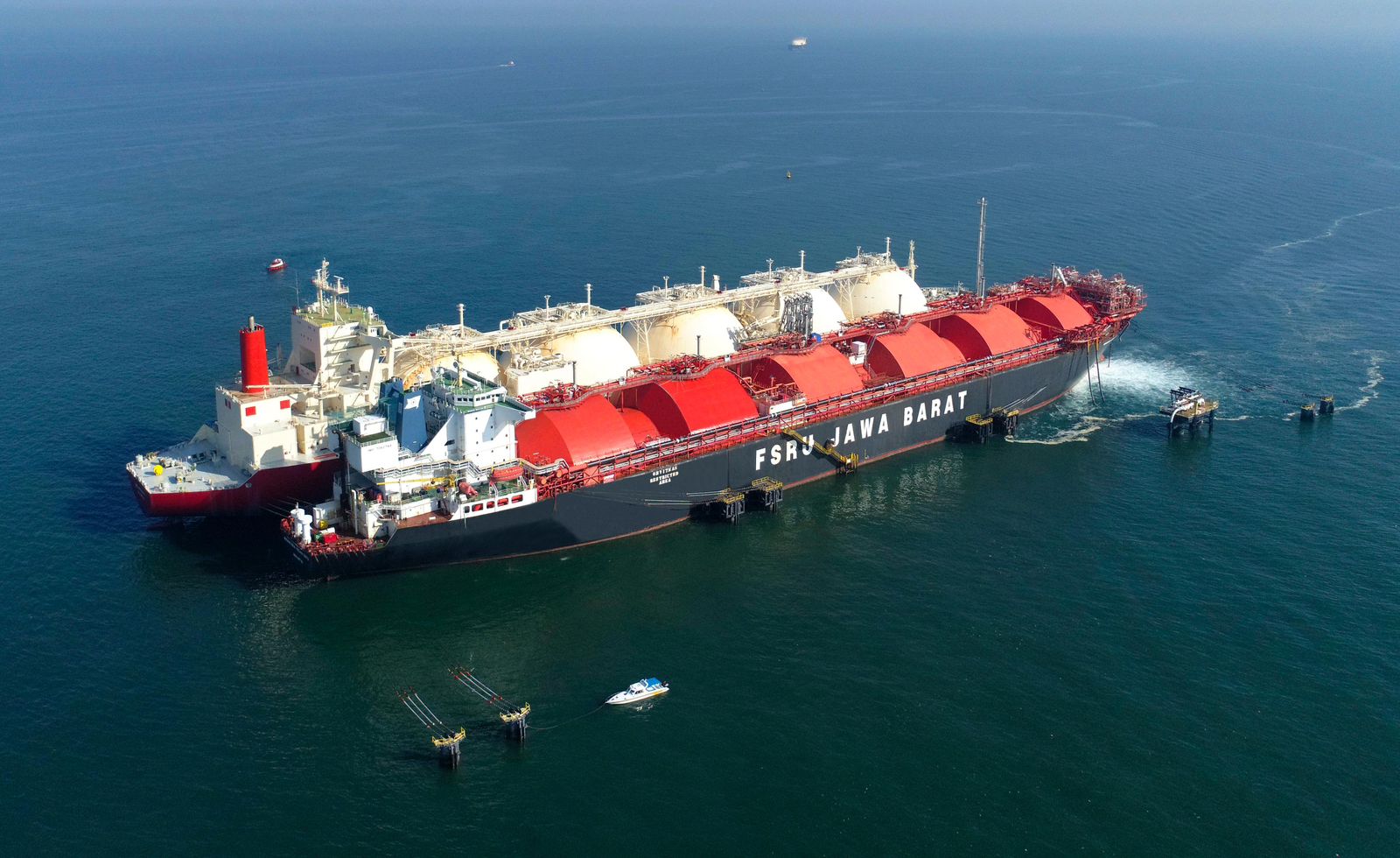
Two FSRUs underpin West Java’s gas reliability—FSRU Nusantara Regas and FSRU Jawa Satu. Together, they provide up to 800 MMSCFD of regasification capacity. A third unit, FSRU Lampung, strengthens the system by adding optionality across the three-FSRU network, bringing total regasification capacity to up to 1,000 MMSCFD. In practice, however, all three units remain dependent on cargo availability, terminal access, and reliable shipping windows.
This is why LNG security is increasingly a matter of logistics discipline. Nusantara Regas is designed to receive carriers in the ~125,000–175,000 m³ range, with typical single deliveries of around ~130,000 m³. Jawa Satu operates on an industrial cadence, completing roughly 19 to 27 ship-to-ship (STS) transfers per year using ~125,000–155,000 m³ cargoes. When vessel availability tightens, or when weather and berthing schedules slip, the impact is immediate: system-level flexibility narrows quickly.
As global shipping markets fluctuate, Indonesia’s LNG reliability is shaped not only by supply and contracts, but also by fleet availability and freight economics. The takeaway is straightforward: when LNG becomes the backbone, shipping is not an afterthought—it is an integral part of the supply system.
Two policy lenses are now in tension, and why one must lead
Two policy lenses are increasingly in tension.
One, where price and efficiency became the legacy frame. Historically, LNG is viewed as a complement: flexible but relatively expensive, used when pipeline deliverability is insufficient, with high dependence on a stable supply once contracts are in place.
Two, where gas is viewed as a means of supplying security and system resilience. The central question becomes whether gas is physically available, delivered on time, and reliable under real-world constraints.
These two lenses are the reason why countries that take LNG security seriously look beyond headline prices. They examine who controls the logistics chain, how the system performs when shipping corridors tighten, and what contingency arrangements are in place when delivery cadence is disrupted by vessel availability or weather.
Domestic-First Allocation Helps, but it is not a Reliable Strategy
Indonesia has a relatively strong domestic LNG resource base. However, domestic molecules alone do not automatically guarantee Java’s physical reliability. Once gas is processed into LNG, it enters a system shaped by contract terms, shipping constraints, and global market signals.
With West Java’s power sector driving an LNG requirement increase of up to 10 cargoes, the priority must shift from policy slogans to operational execution: securing incremental cargo access, ensuring vessel availability, and establishing credible contingency arrangements to manage unexpected tightening in domestic supply.
It is also important to be precise about a common concern: properly contracted LNG cargoes and vessels cannot simply be “taken away” because another market offers a higher price. The more realistic risks are structural—limited fleet availability, cost escalation when capacity must be expanded on short notice, and diversion flexibility embedded in certain cargo arrangements. These are system-design issues, not questions of intent.
Yes, The Shift Is Already Underway
The price lens is not wrong, but it is no longer sufficient. It should be treated as one tool within a broader framework centered on security of supply and system resilience.
In Indonesia’s current phase, security of supply is not the opposite of efficiency, it is a prerequisite for it. In an LNG-based system, reliability is ultimately determined by resource availability, logistics governance, shipping cadence, and contingency design, not by price comparisons alone.