
A biomass power plant does not run on theoretical potential. It runs on feedstock that can be collected, transported, priced, contracted, and supplied consistently over the project lifetime. This distinction is important for Indonesia, a country widely known for its abundant natural resources and agricultural residues that remain underutilized in many regions.
In theory, these residues can become an important feedstock source for biomass power plants, or PLTBm. As an initial screening rule of thumb, around 8,000–12,000 tonnes of solid biomass per year may be required to support 1 MW of biomass power capacity, depending on moisture content, calorific value, conversion efficiency, and capacity factor. This means that even a small biomass power plant requires a continuous and organized supply chain, not just a one-time estimate of residue volume.
Indonesia has various biomass sources, ranging from agricultural residues such as rice husk, rice straw, corn cob, coconut husk, and coconut shell, to agro-industrial residues such as sawdust and woodchip. However, the key issue is not only how much biomass exists, but how much biomass is actually collectable, available, affordable, sustainable, and contractable for long-term PLTBm operation.
In practice, the amount of biomass that can realistically be used is usually much smaller than the theoretical residue potential. Some residues are already used locally for animal feed, soil return, household fuel, charcoal production, small industries, or other commercial purposes. Others are scattered across wide areas, making collection more difficult and costly compared to residues that are already concentrated in processing facilities, such as rice husk from rice mills or sawdust from wood-processing industries.
This makes collectability a key factor in PLTBm development. A feedstock that looks abundant and cheap at the source may become expensive once collection, loading and unloading, drying, storage, transport, and handling losses are included. In many cases, biomass is more economically viable when the supply source is located within a reasonable distance from the power plant, often around 50–100 km depending on road conditions, transport mode, biomass density, and plant scale. Road access, transport infrastructure, and supply-chain accessibility therefore play a major role in determining whether biomass can be used competitively.
Existing market competition also affects feedstock availability. Several biomass types already have established markets, which may reduce their availability for PLTBm. Coconut shell, for example, has potential as biomass feedstock, but it is also widely used for charcoal, briquettes, and activated carbon, including for export markets. If PLTBm developers cannot secure long-term supply at a competitive price, the project may face feedstock security risks.
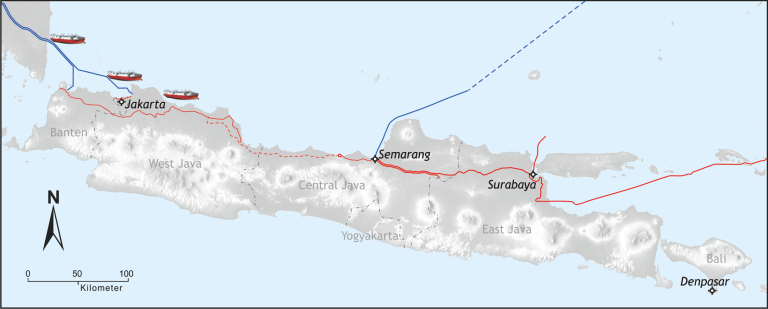
For this reason, biomass assessment should move beyond theoretical potential. A comprehensive assessment needs to evaluate not only volume, but also ownership, current utilization, seasonality, quality, price, logistics, competing uses, and willingness of suppliers to enter into long-term agreements. GIS-based mapping can support this process by showing the spatial relationship between biomass sources, transport infrastructure, grid access, and potential PLTBm locations.
Ultimately, the most important biomass for PLTBm is not simply the biomass that exists. It is the biomass that can be accessed, collected, transported, priced, contracted, and supplied sustainably over the long term. In this sense, biomass assessment is not merely a resource mapping exercise. It is a supply-chain and bankability assessment. Indonesia’s biomass opportunity is real, but turning that potential into reliable power requires a shift from resource estimation to feedstock readiness.